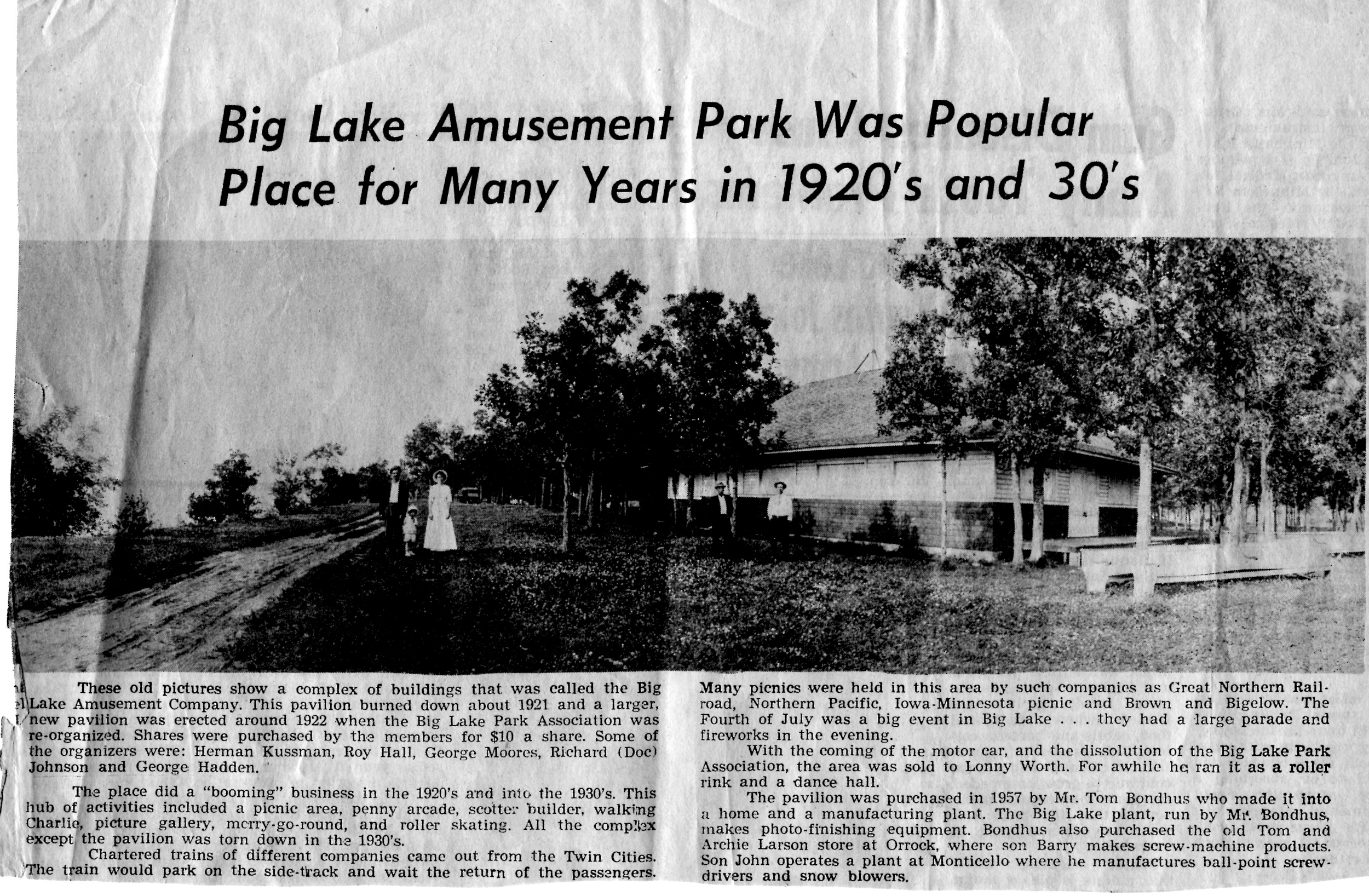
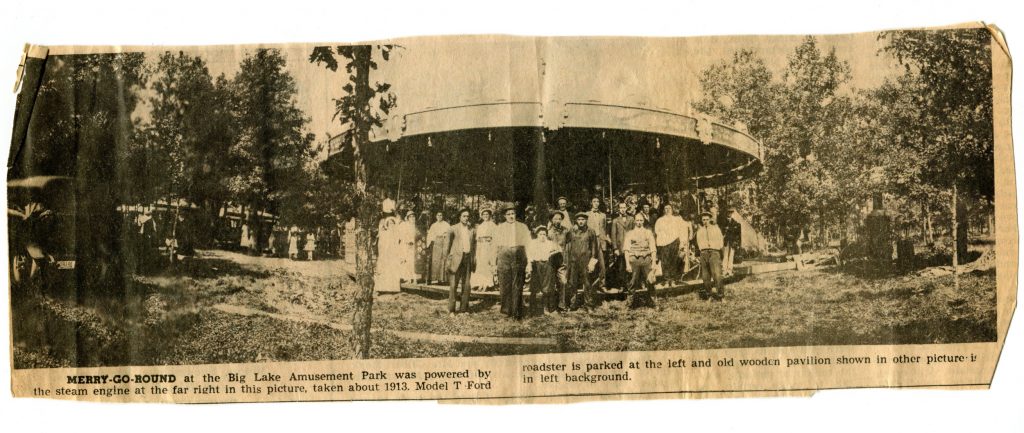
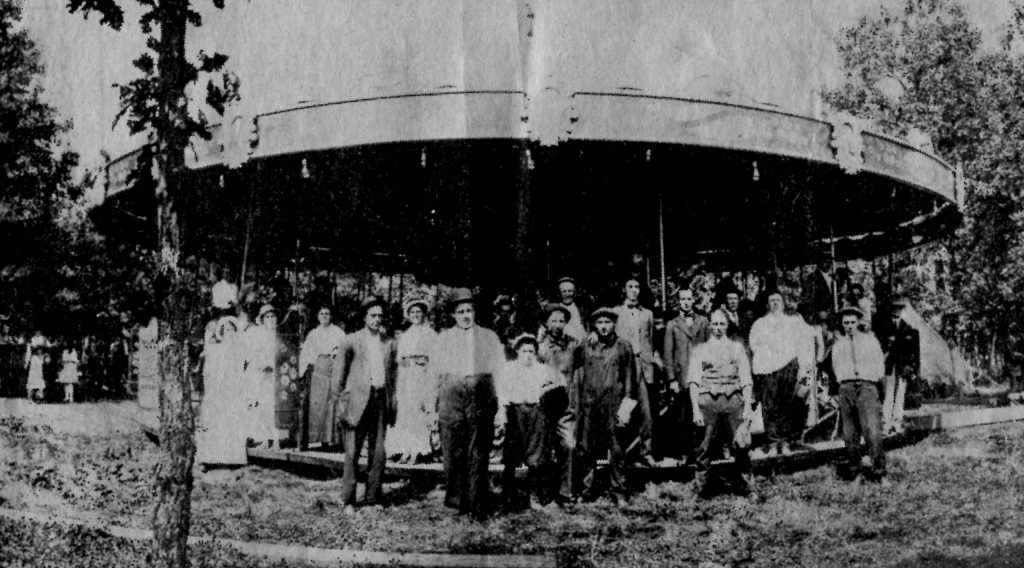
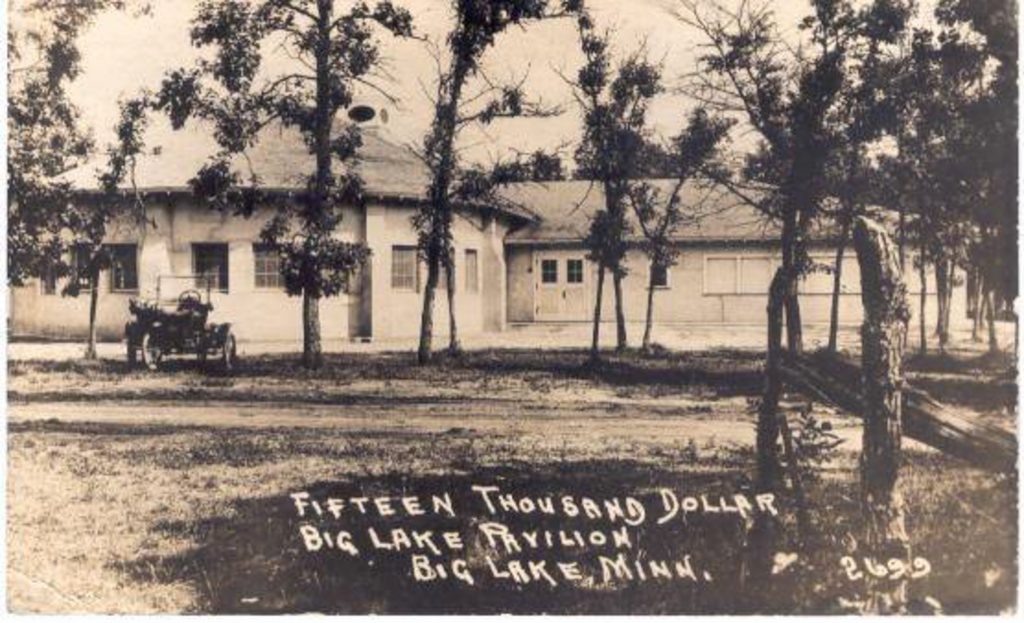
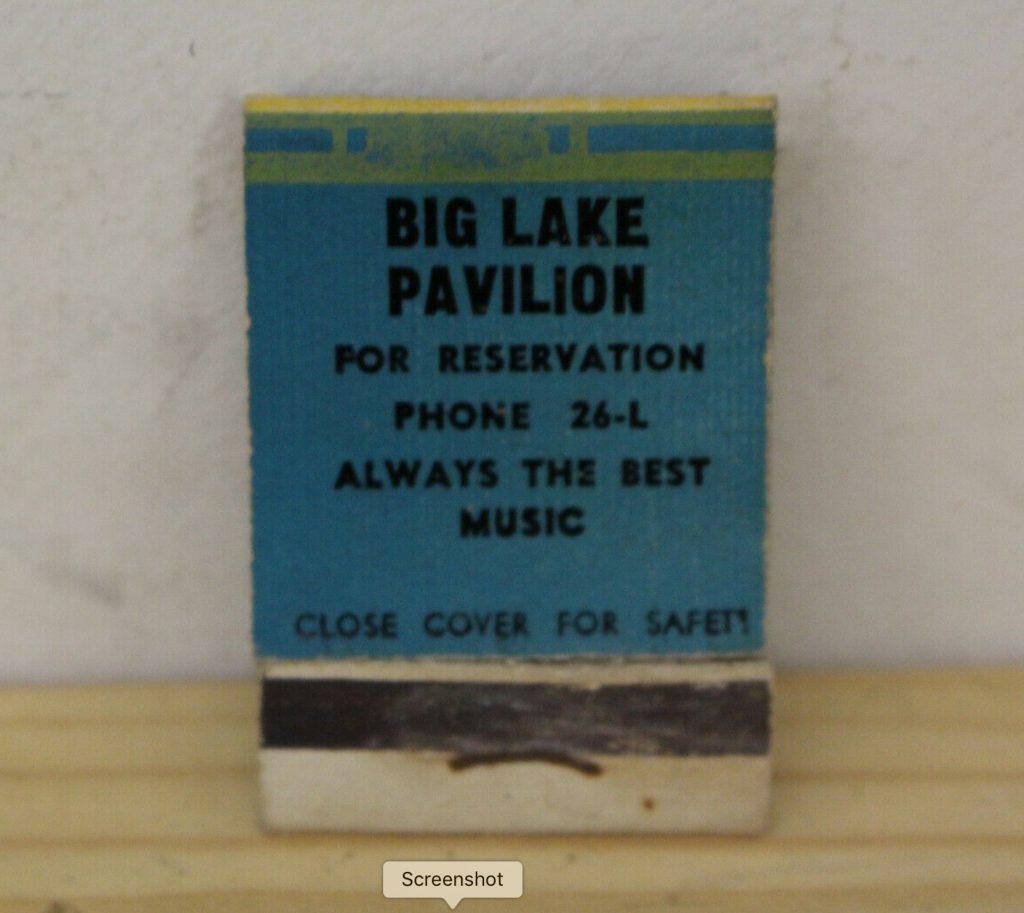
These old pictures show a complex of buildings on 10 acres that was called the Big Lake Amusement Company. This pavilion burned down about 1921 and a larger new pavilion was erected around 1922 when the Big Lake Park Assoication re-organized. Shares were purchased by the members for $10 a share. Some of the organizers where Herman Kussman, Roy Hall, George Mores, Richard (Doc) Johnson and George Hadden.
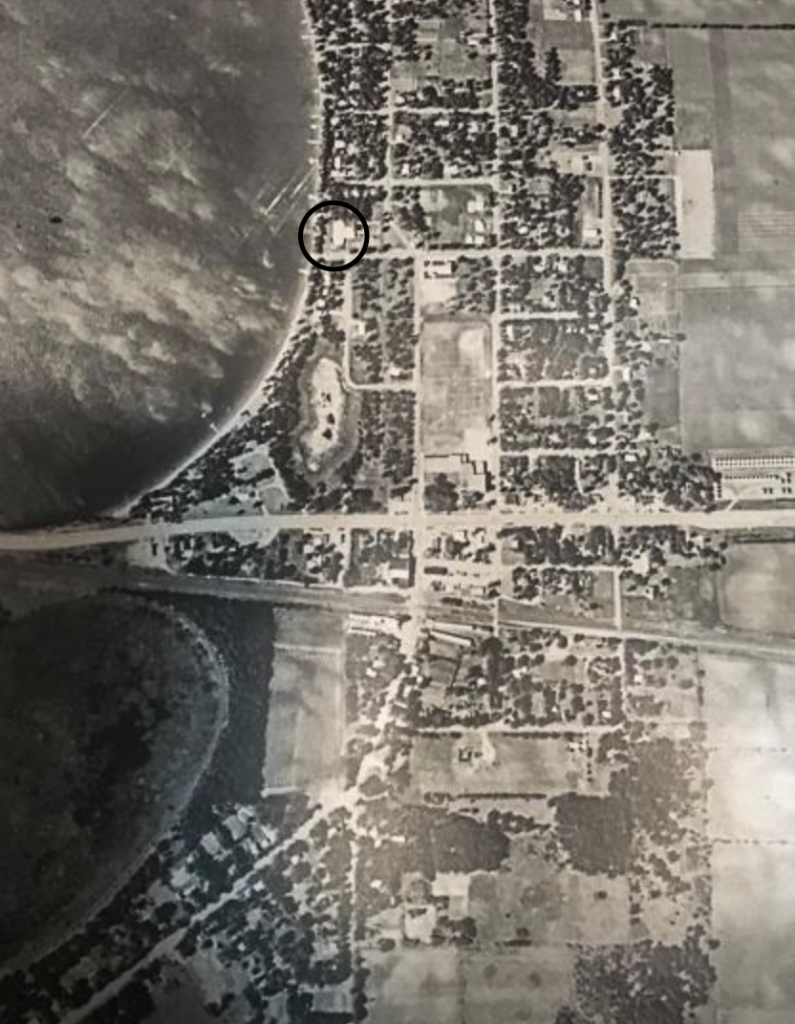
The place did a “booming” business in the 1920’s and into the 1920’s. This hub of activities included a picnic area, penny arcade, scooter builder, walking charlie, picture gallery, merry-go-round, and roller skating. All the complex except the pavilion was torn down in the 1930’s. The pavilion was quite large and could accommodate 1600 to 1700 people. It was eventually torn down in 1994 and at the time was painted salmon/pink color that certainly made it stand out. It was kitty corner from the Catholic church.
Ira Shank was interviewed for the West Sherburne Tribune and mentioned the Pavilion when talking about what activities there were for kids in his days. “For entertainment, there was bowling, the dance pavilion, which attracted such great names as Lawrence Welk, the amusement park, complete with a roller coaster and carousel, and movies, outside, set up on the school football field, now owned by Our Lady of the Lake Catholic Church.”
Rod Hunt includes a reference to the Pavilion in his Book A Boy’s Guide to Big Lake, Minnesota and other stuff, when describing the difference between the “free swimming” beach and the Brown’s swimming beach that costs $.05. “On the free beach you got nothing. You wore your swimming suit under your clothes, if you are lucky you remembered to have a towel, stripped to the suit on the sharp incline in front of the pavilion, entered the water over the rocks, watched for broken bottles (some were still there from the prohibition days when the guys at the dances would tie a string on their bootleg booze and hide it in the lake) until you got out far enough to get wet above the waist and then sunk into the mud or engaged in the ishy business of ooze and slimy weeds.”
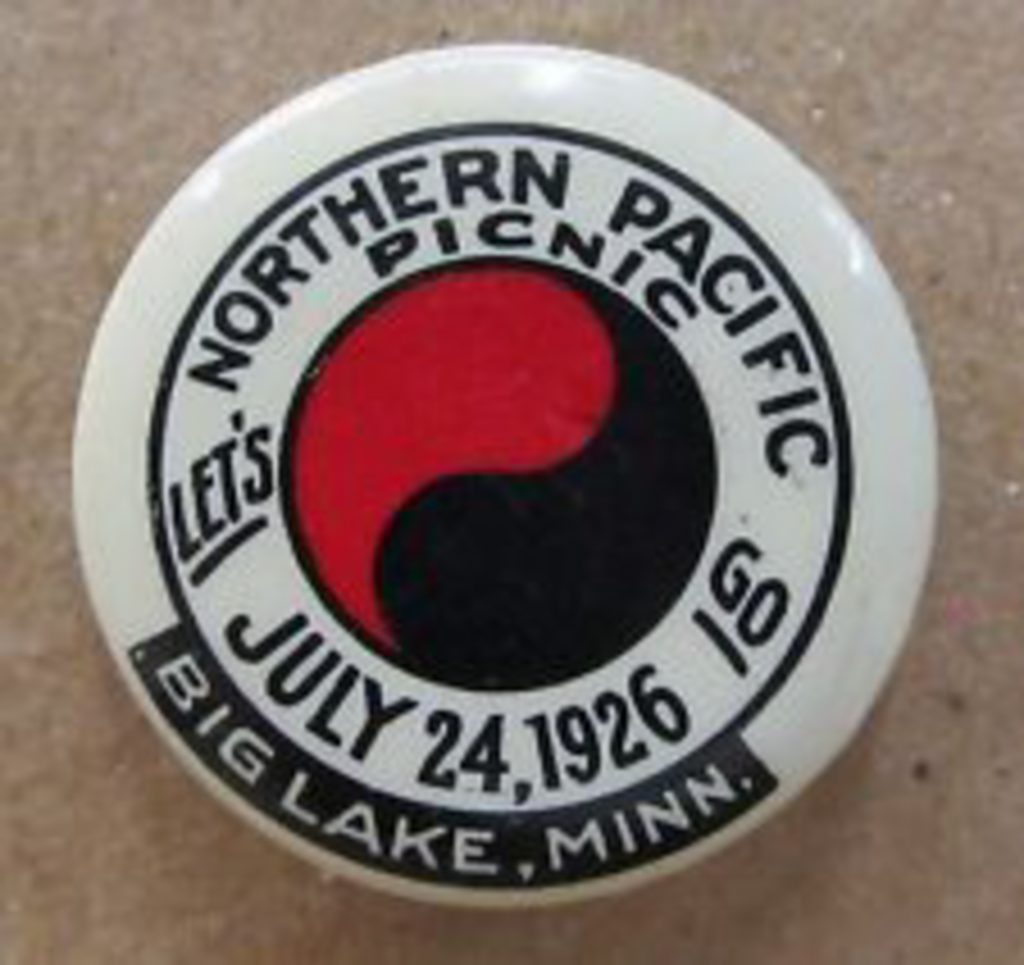
Chartered trains of different companies came out from the Twin Cities. The train would park on the side-track and wait the return of the passengers. Many picnics where held in this area by such companies as Great Northern Railroad, Northern Pacific, Iowa-Minnesota picnic and Brown and Bigelow. The Fourth of July was a big event in Big Lake … they had a large parade and fireworks in the evening.
With the coming of the motor car, and the dissolution of the Big Lake Park Association, the area was sold to Lonny Worth. For awhile he ran it as a roller rink and a dance hall.
The pavilion was purchased in 1957 by Mr. Tom Bondhus who made it into a home and a manufacturing plant. The Big Lake Plant, run by Mr. Bondhus, makes photo-finishing equipment. Bondhus also purchased the old Tom and Archie Larson store in Orrock, where son Barry makes screw-machine products. Son John operates a plant at Monticello where he manufactures ball-point screw drivers and snow blowers.
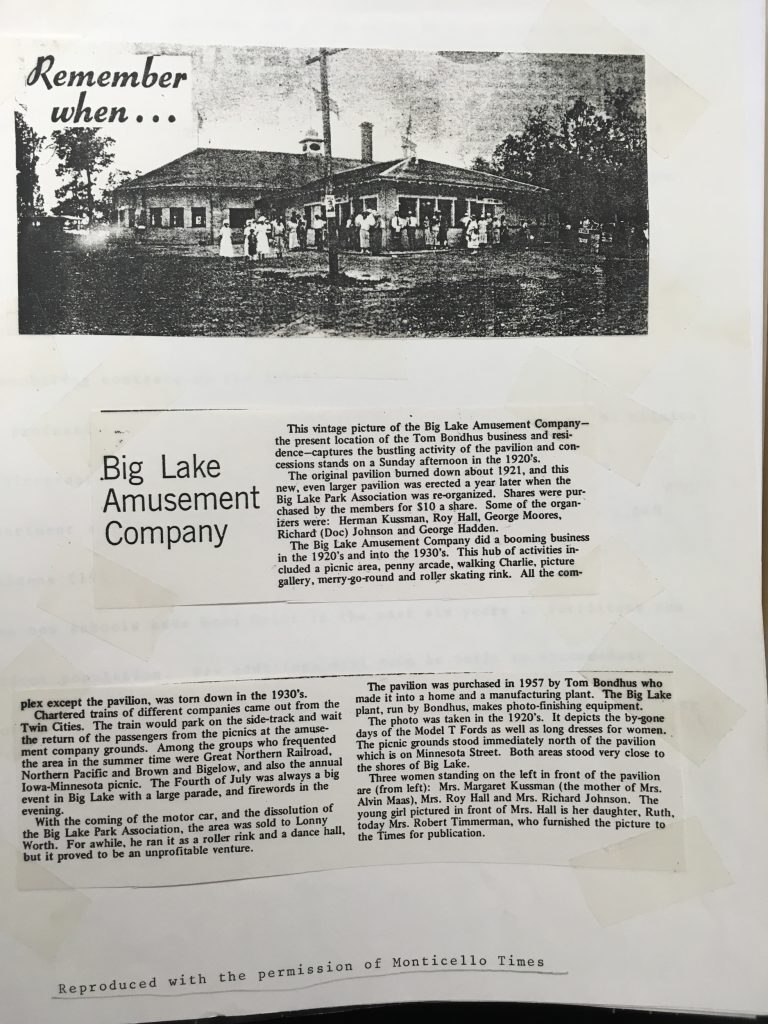
The woman standing on the left in front of the pavilion are (from left): Mrs. Margaret Kussman (the mother of Mrs. Alvin Maas), Mrs. Roy Hall and Mrs. Richard (Doc) Johnson. The young girl pictured in front of Mrs. Hall is her daughter, Ruth, today Mrs. Robert Zimmerman, who furnished the picture to the times for publication.

Leave a Reply